2D vs 3D vs Hybrid Animation: Which One Fits Your Project
Written by Myth Studio
Studio Post
2D animation is flat, illustrated, and built frame by frame or on rigs. 3D animation is sculpted, lit and rendered inside a virtual space, with cameras moving through it. Hybrid 2D/3D animation pairs the two: dimensional environments and camera moves built in 3D, characters and surfaces painted in 2D. 2D suits work led by graphic identity and warmth. 3D suits scale, physical realism, and creative camera. Hybrid suits briefs that need both at once.
_1770741326326.webp)
This piece is about choosing between 2D, 3D, and hybrid 2D/3D as visual pipelines. It is not about AI as a technique. For AI as a production tool, see Myth Labs AI video production or read how artists can use AI without losing the craft. For the broader question of AI's role in the medium, see Will Animation Be Replaced by AI?
Key takeaways
- 2D suits illustrative animations, abstract concepts, social and explainer work. 4 to 8 weeks for a 30-second broadcast piece.
- 3D suits physical realism, architectural scale, free camera work, and projects revisiting the same world across many shots. 6 to 12 weeks for a 30-second broadcast piece.
- Hybrid 2D/3D suits briefs that ask for warmth and scale at once, or illustration register at broadcast ambition. 4 to 12 weeks for a 30-second broadcast piece, depending on how heavily procedural and AI-assisted asset preparation feature.
- Procedural systems in 3D and frame-by-frame art direction in 2D are the two capabilities that most clearly separate the pipelines. Hybrid is where they meet.
- A good brief states the message, audience, tone, budget, and broadcast context, and lets the studio recommend the pipeline.
2D animation
2D animation is the family of techniques that produce flat, illustrated motion. Inside that family sit hand-drawn frame-by-frame work, rigged 2D character animation (puppets built from layered illustration parts), cel animation, cut-out animation, and motion design built from vector or raster assets. After Effects, Toon Boom, Cavalry, and Procreate Dreams are common production tools.
What 2D does well is graphic identity. A 2D piece looks like illustration in motion. It is light, characterful, and brand-flexible, which is why it dominates explainer videos, social campaigns, music videos, and a great deal of broadcast advertising. It handles abstraction with ease: concepts, feelings, metaphors. It moves at the speed of a sketch.
Frame-by-frame work in particular unlocks a register of art direction that no other pipeline can replicate. Because every frame is drawn from scratch, the visual language can shift inside a single shot: line weights can breathe, palettes can drift, perspective can collapse and rebuild, and the surface itself can carry meaning the moving image alone cannot. The cost is labour. A frame-by-frame piece with that kind of art direction takes animator hours that rigged 2D or 3D simply do not.
What 2D does less well is physical scale and weight. A 2D piece is, by definition, planar. You can fake depth with parallax, scale, and atmospheric tricks, but the audience reads the image as a surface. Big architectural moves, sweeping cameras through environments, and shots that rely on physical lighting are all harder in pure 2D, and at scale they get expensive in animator time.
3D animation
3D animation builds the scene inside a virtual space. Every object is modelled, textured, rigged, lit, and rendered by software like Maya, Blender, Cinema 4D, Houdini, or Unreal. The camera is a virtual object inside that space and can move through it freely.
3D earns its place when you need physicality. Real-world materials (metal, fabric, skin, water, food). Convincing weight. Architectural scale. Cameras that swoop and orbit. Lighting that behaves like lighting. 3D is the default for product visualisation, automotive work, broadcast title sequences with epic scale, character-led commercials that need consistency across many shots, and any project where the same world needs to be revisited from many angles.
Procedural systems are the other major capability 3D pipelines hold over 2D. Procedural systems inside software like Houdini and Cinema 4D allow assets to be generated, duplicated, and varied algorithmically. A single building can be scattered across a virtual city in minutes. A forest can be grown from one tree. A crowd can be assembled from a handful of base figures, each with their own randomised pose and clothing. The kind of scene that would consume weeks of frame-by-frame work in 2D can be assembled, lit, and re-shot in a fraction of the time inside a procedural 3D pipeline.
The trade-off is that 3D pipelines are heavier. The cost is loaded into the build phase: modelling, rigging, surfacing, look development. Once the assets exist, output can scale, but the up-front investment is significant. A 30-second 3D character piece rarely runs lighter or faster than a 30-second 2D character piece.
3D also carries a tonal weight. By default, 3D output reads as 3D, which can feel slick, polished, or corporate in contexts that wanted warmth. This is why a great deal of 3D work spends real effort fighting against the default 3D look. That brings us to the hybrid.
Hybrid 2D/3D animation
Hybrid 2D/3D animation is the pipeline that uses 3D for what 3D is good at (space, scale, camera, layout, lighting, consistency) and 2D for what 2D is good at (character, surface, brand identity, warmth). The two halves are integrated so the final piece reads as a coherent work, not as a 3D film with 2D logos on top.
The practical mechanics vary by studio and by project. Common patterns include:
- Building environments and props in 3D, then projecting illustrated textures onto them.
- Animating characters in 2D against a 3D background, with the camera and parallax driven by the 3D scene.
- Animating characters in 3D, then re-rendering them through stylised shaders that produce a 2D illustrated finish.
- Using 3D as a previs and layout tool, then producing the final frames in 2D, with the 3D scene driving the camera moves and the staging.
The pairing also unlocks something neither pipeline can do alone at speed. Procedural 3D systems can build out a complex scene (a city, a forest, a crowd, an interior with hundreds of props) in a fraction of the time a hand-built scene would take. A 2D art direction pass applied on top of those scenes carries the warmth, line, and graphic character that procedural 3D, by default, will not produce. The result is a frame-by-frame register applied to scenes that frame-by-frame alone could not have afforded.
Hybrid is harder to write a job advert for than pure 2D or pure 3D. It needs senior people who can think across both pipelines and a comp team who can hold the two halves together. But the output ceiling is high, and the look is genuinely distinctive in a market where pure 3D has a habit of looking generic.
Side by side
| Dimension | 2D | 3D | Hybrid 2D/3D |
|---|---|---|---|
| Visual character | Illustrated, graphic, warm | Sculpted, dimensional, physical | Illustrated finish on dimensional space |
| Best for | Explainers, social, music videos, brand campaigns with strong illustration | Product visualisation, automotive, broadcast titles with scale, character commercials | Title sequences, brand films, work that needs warmth and scale at once |
| Camera | Limited to faked depth and parallax | Free, six degrees of motion | Free, with a 2D finish |
| Scene replication | Hand-built, animator hours | Procedural at scale | Procedural under a 2D pass |
| Up-front asset build | Lower | Higher | Higher than 2D, comparable to 3D |
| Typical timeline for a 30s broadcast piece | 4 to 8 weeks | 6 to 12 weeks | 4 to 12 weeks |
| Senior craft demand | Strong illustration and animation | Strong CG and lighting | Strong in both, plus comp |
| Default risk | Can feel flat at scale | Can feel generic without care | Falls apart if the two halves are not integrated |
Ranges above are indicative for UK broadcast tier work and shift with style, character count, and revision scope.
Case study: ITV Euro 2024, where 3D produced a 2D finish
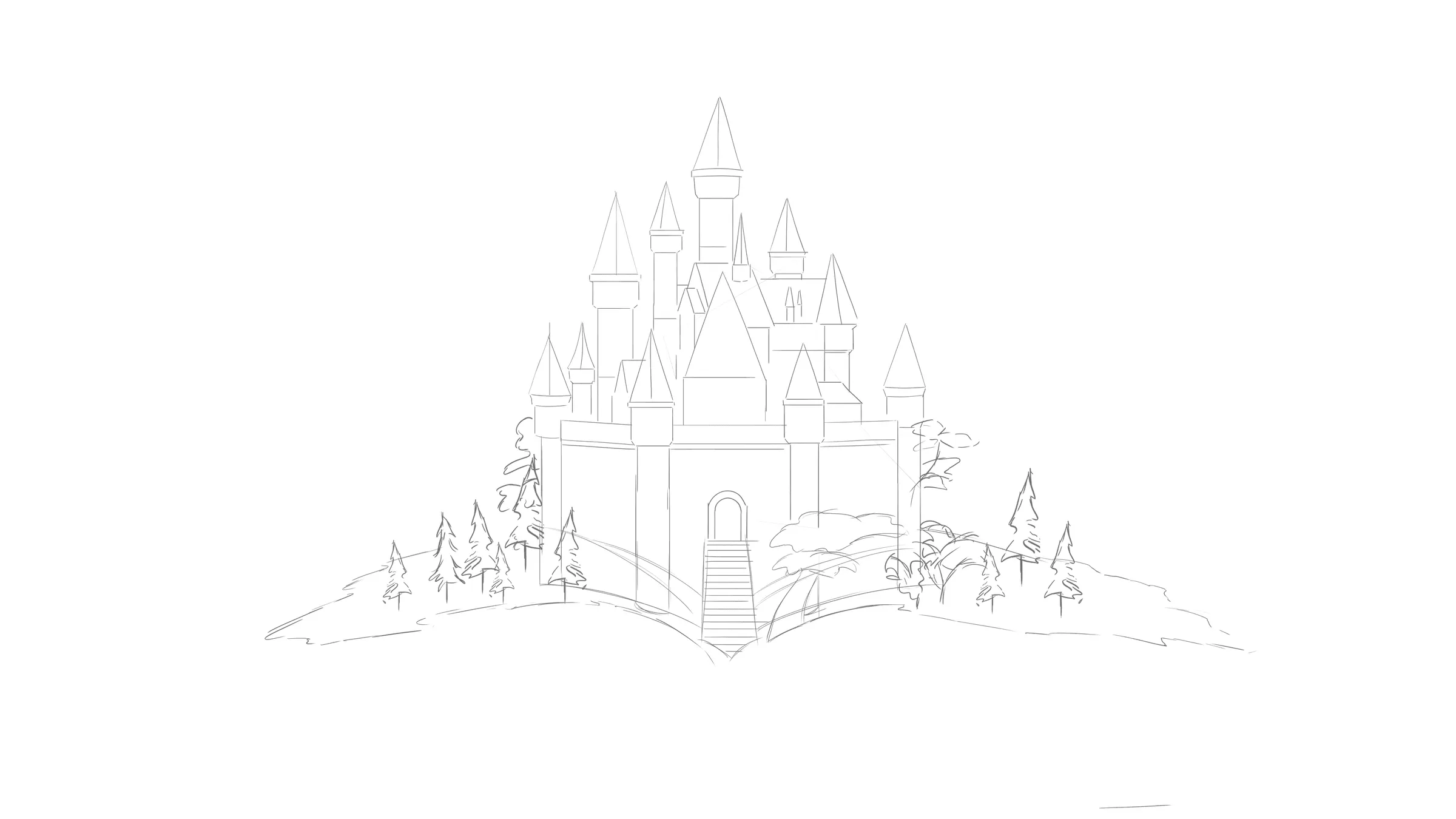
In early 2024, Noah Media Group brought us a brief for the ITV Sport Euro 2024 opening title sequence. The concept was already strong: a Brothers Grimm-inspired paper world, with the tournament's football legends reimagined as fairytale characters in a pop-up storybook universe.
The brief carried a visual contradiction that had to be resolved at a pipeline level. The world needed to feel hand-crafted, tactile, theatrical, as though it could fold away at the end of the broadcast. That is a 2D illustration register. At the same time, it needed to unfold across a prime-time ITV Sport title sequence at full broadcast scale, with cameras travelling through forests, into castles, across landscapes, holding up against the kind of visual ambition the audience expects from a major tournament opening.
A pure 2D pipeline would have struggled with the camera work and the scale. The shot list would have either compressed dramatically or each shot would have eaten weeks in hand-built parallax. A pure 3D pipeline would have delivered the scale comfortably but would have killed the storybook register. The default 3D look reads as digital, and the Brothers Grimm register depends on reading as handmade.
The answer was a hybrid pipeline built specifically for the project. The environments were constructed in 3D: forests, castles, landscapes, all with proper depth and proper cameras. The characters were animated in 2D, hand-drawn and rigged, with the kind of expressive line work the storybook register demands. Custom paper textures ran through the entire sequence, applied as surfaces in the 3D scenes and as treatments in the 2D character work, so that everything from a castle wall to a wolf's coat read as torn or pressed paper.
_1770741326326.webp)
Behind the scenes, the integration was the hard part. Spatial and camera data flowed from the 3D scenes into the 2D animation, so the characters lived convincingly inside the world and moved with the camera correctly. The 3D scenes produced flexible render passes, which gave the comp team the precision they needed to hold the two halves together. The final sequence reads as one coherent piece of work, not as a 3D film with 2D characters dropped on top.
The production ran over sixteen weeks. The film reached more than 23 million viewers across the tournament and was a favourite of the Guardian.
The reason the project is worth holding up as a case study is not the technique. It is the decision logic. The brief contained a contradiction (tactile and theatrical, broadcast scale and ambitious camera). A single-pipeline answer would have lost something. The hybrid answer kept both halves of the brief intact. That is when hybrid earns its place: when the brief itself asks for two things that no single technique can deliver at the level required.
When 2D earns its place
2D is the right answer when the project lives or dies on graphic identity. Explainer videos. Social campaigns with strong brand illustration. Music videos. Charity work where the character of the line carries the message. Anything where the visual register is already illustrated and where adding dimensional depth would feel out of place.
2D is also the right call when the timeline is tight and the budget is constrained. A skilled 2D team can produce a high-craft 30-second piece in four to eight weeks. A 3D team rarely can.
2D also earns its place when the concept is abstract, conceptual, or metaphorical. 2D handles abstraction better than 3D because it does not have to render anything physical. A 2D animator can move from concept to concept across cuts in ways that a 3D pipeline finds expensive.
When 3D earns its place
3D is the right call when physical realism is the point. Product visualisation. Food. Automotive. Materials. Anything where the audience needs to read the object as physically real.
3D is also the right call when the same world needs to be revisited from many angles or across many shots. A built 3D world pays back its build cost across the run. A built 2D world has to be redrawn.
3D earns its place when the camera is doing creative work. Long takes, orbits, sweeping moves, parallax through architectural space. 3D was designed for this and produces it natively.
3D is also the right answer when the scene itself is large or replicated. Cities, forests, crowds, stadiums, fleets, large interiors. A procedural 3D pipeline can build a city out of one building, populate a forest from one tree, or scatter a hundred props into a room in less time than it would take to draw one of them by hand. That capability is most of the reason 3D is the default register for major film, TV, and sport title sequences with broadcast scale at high fidelity. The scale and lighting are part of the message, and the budget and timeline are sized to match.

When hybrid earns its place
Hybrid is the right answer when the brief asks for two things at once that a single pipeline cannot deliver. Warmth and scale. Illustration and physical camera. Brand character and broadcast ambition. The ITV Euro 2024 sequence is the textbook example. A pop-up storybook is, by definition, a flat illustrated thing pretending to be a dimensional thing. A hybrid pipeline is the only honest production answer to that brief.
Hybrid is also the right call when the goal is a distinctive look in a market saturated with default 3D. A great deal of modern brand and broadcast work uses 3D and reads broadly the same. Stylised hybrid pipelines, where 3D drives the layout and 2D drives the finish, produce visual identities that competitors cannot copy quickly.
Hybrid is also the practical answer when a project needs the scene complexity that procedural systems afford and the visual character that frame-by-frame art direction affords, on a single budget and timeline. Procedural 3D builds the scene at speed, the 2D art direction pass carries the look. That combination produces work that pure 2D could not have afforded and pure 3D would not have been distinctive enough to justify.
The cost of going hybrid is mostly senior craft demand. The pipeline needs people who can think across both halves and a comp team who can integrate them. That is the right cost to pay when the brief demands it. It is the wrong cost to pay when one technique alone would have done the job.
Frequently asked questions
Which is faster to produce: 2D, 3D, or hybrid animation?+
Do I need to specify 2D, 3D or hybrid in my brief?+
Can AI shorten the build cycle of 3D or hybrid animation?+
Does hybrid count as 2D or as 3D for casting and crewing purposes?+
Can I switch from one approach to another mid-production?+
How will a studio decide which pipeline is right for my project?+
Have a project in mind?
If you are at the briefing stage and want senior creative and technical input on which pipeline your project needs, get in touch. Most briefs clarify quickly in a 20-minute conversation.
Sources
- Williams, R. The Animator's Survival Kit. Faber & Faber, 2001. Supports: 2D principles and frame-by-frame craft.
- Lasseter, J. "Principles of Traditional Animation Applied to 3D Computer Animation." ACM SIGGRAPH Computer Graphics, 21(4), 1987. Supports: 3D inheriting from 2D craft principles.
- Catmull, E., Wallace, A. Creativity, Inc. Random House, 2014. Supports: hybrid pipelines in modern studio production.
- Parent, R. Computer Animation: Algorithms and Techniques. Morgan Kaufmann, 2002. Supports: 3D production pipeline and rendering.
- Sony Pictures Imageworks. "Non-photorealistic Compositing of the Spider-Verse." ACM SIGGRAPH 2023 Talks. Supports: production-scale hybrid pipelines marrying procedural 3D with artist-led 2D treatment.
- Sony Pictures Imageworks. "Linework in Spider-Man: Across the Spider-Verse." ACM SIGGRAPH 2023 Talks. Supports: stylised hybrid pipelines and the procedural-versus-handmade trade-off in current feature animation.
- Toon Boom. "Behind the amazing 2DFX in Spider-Man: Across The Spider-Verse." 2023. Supports: combining 2D effects work with procedural 3D in a single production pipeline.
Key Takeaways
- 2D suits illustrative work, abstract concepts, social and explainer pieces, and lands a 30-second broadcast piece in 4 to 8 weeks.
- 3D suits physical realism, architectural scale, free camera work, and worlds revisited across many shots, at 6 to 12 weeks for a 30-second broadcast piece.
- Hybrid 2D/3D suits briefs that ask for warmth and scale at once, and runs 4 to 12 weeks depending on how heavily procedural and AI-assisted asset preparation feature.
- Procedural systems in 3D and frame-by-frame art direction in 2D are the two capabilities that most clearly separate the pipelines. Hybrid is where they meet.
- A good brief states the message, audience, tone, budget, and broadcast context, and lets the studio recommend the pipeline. ITV Euro 2024 is the worked hybrid example.
Continue Reading
AI animation, traditional animation, or hybrid: when to choose each approach
How Long Does Animation Take? A Complete Guide to the Animation Process